A blog by Wongsathit Intawong (Em) Wildlife Researcher for Freeland.
Since 2019, WildCats has supported Freeland’s work in Thailands Khao Laem National Park, funding tiger monitoring, ranger training, and community workshops that reduce conflict.

On 16th June 2026 as word reached Freeland that a tiger in Khao Laem National Park had killed a farmer’s cow we mobilised quickly to help the Department of National Parks, Wildlife and Plant Conservation officials to confirm if it was either a tiger or leopard that killed the cow and to safeguard it while it remained in the vicinity returning each night to feed on the carcass.
Freeland stepped in to assist Khao Laem officials by providing camera traps and advice, while two ranger teams remained in the vicinity to prevent any local villagers inadvertently wandering into a potentially dangerous area. Initially, two cameras were deployed and later several more to monitor which direction the animal moved towards. Villagers in several communities were warned about the event. Unfortunately, the national press got hold of the story and park management became concerned about curious tourists, or even poachers also entering the area.
Monitoring the situation
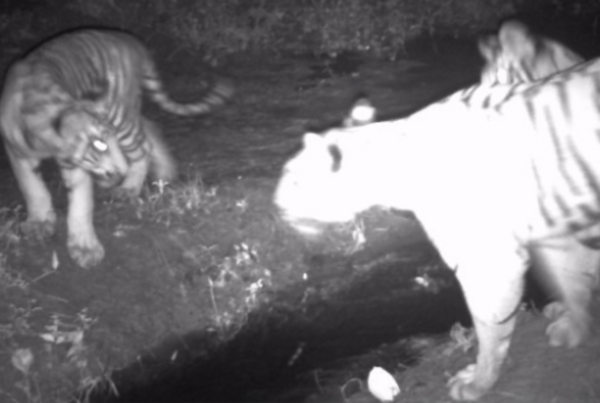
The camera traps provided by Freeland captured a large male Indochinese tiger returning to claim its kill. There is always a breath-taking gravity when you see a healthy apex predator, especially this close to human settlements, and it immediately heightened the urgency of the mission. The images were shared with the Khao Nang Ram Wildlife Research Station and with partner organisations to identify the individual tiger to understand where it had originated.
For three days, we worked with the rangers on an intensive, 24-hour monitoring operation. The primary goal was to ensure the safety of the tiger while it ate the cow, protecting it from potential poachers or frightened locals, or curious tourists while simultaneously keeping the nearby community safe. It was scary but vital work, keeping watch in the forest while the tiger finished feeding.


The team setting up the camera trap and the image of the tiger it caught ©Freeland / DNP
Working with the community
To prevent retaliatory poaching, we went with the park’s community outreach team to meet the cattle owner. Retribution is a massive threat to tigers when livestock is lost, and we wanted to mitigate any anger he may have and find a peaceful resolution.
However, the meeting took a surprising turn. As we talked with the owner, we found he wasn’t looking for revenge. In fact, he openly admitted that he had been grazing his cows illegally within the national park boundary. He understood the risks he had taken and accepted that the forest belonged to the tiger.

Ranger investigating the carcass © Freeland / DNP
What happened to the tiger?
A week later the tiger left the area, and no more cattle were predated. Then NGO, Panthera, kindly shared their images of the tiger recorded in another reserve called Erawan National Park, more than 100 kilometres away. Due to a combination of factors, including low prey densities, limited availability of prime habitat and the dispersal behaviour of sub-adult tigers, tigers in the South Western Forest Complex are highly mobile. Over the past year, including this latest record, four young male tigers have been documented moving through Khao Laem. This highlights the important role of Khao Laem as a corridor facilitating tiger movement across the wider transboundary landscape.
Despite tigers and leopards living quite close to communities in Khao Laem, this type of event is actually highly unusual. In fact, the last time a conflict like this happened was three years ago, very close to where this latest incident occurred.
Because the cattle owner held no resentment, a situation that could have easily escalated into a crisis ended with remarkably few negative outcomes. This breakthrough made our community relations much smoother. While the rangers continue to warn local villagers to stay out of the high-risk zone for their own safety, this incident highlights the power of collaboration. By providing the right technology, pulling shifts alongside dedicated Department of National Park, Wildlife and Plant Conservation (DNP) rangers, and engaging rapidly with the community, we can protect Thailand’s remaining tigers, even when they wander a little too close to human habitations.

Tiger Photographed 100km away ©Panthera